
Flow battery systems are in service on every continent, in applications ranging from commercial and industrial installations of a few hundred kilowatt-hours to grid-connected systems of several hundred megawatt-hours. This page summarises where the technology is deployed, drawing on the operating experience reported at the International Flow Battery Forum.
Scale of deployment
Flow batteries have a small share of installed electrochemical storage. Analysis presented at IFBF 2025 put cumulative flow battery deployment for the period 2010 to 2022 at 828 MWh, against more than 39,000 MWh of lithium-ion battery storage deployed globally in 2022 alone, and an installed lithium-ion base of 159 GW and 358 GWh at the end of 2024.
The distribution is also uneven. China has the most flow battery installations, and large projects remain comparatively uncommon elsewhere. The significant development of recent years is not the total installed volume but the scale of individual projects, which has increased by two orders of magnitude in a decade.
The largest installations
The progression of the largest single flow battery installation illustrates the change:
- 2013 — a 5 MW / 10 MWh vanadium system installed by Rongke Power at a 50 MW wind farm in China, at the time the largest in the world.
- 2022 — the first stage of the Dalian project in China, 100 MW / 400 MWh, with a reported total project investment of US$530 million and provision to expand to 800 MWh.
- 2024 — a 175 MW / 700 MWh grid-forming vanadium flow battery completed in China, reported as the largest in the world.
- 2025 — a system of gigawatt-hour scale commissioned in western China.
Flow batteries were installed and operated long before 2013. For details of earlier flow battery installations, please see the proceedings of the IFBF from 2010 onwards.
Rongke Power reported more than 2 GWh of utility-scale batteries deployed at IFBF 2025 and 2026, against 720 MWh reported in 2024. Invinity Energy Systems reported deployment at more than 70 sites across 15 countries at IFBF 2024, and more than 5.2 GWh discharged from its installed fleet since 2022.
Europe
The largest vanadium flow battery currently operating in Europe is the 2 MW / 20 MWh research system at Fraunhofer ICT in Germany, built to demonstrate ten-hour operation in combination with a wind turbine. It will be surpassed by the 20.7 MWh Copwood Energy Hub in East Sussex, United Kingdom, a vanadium flow battery co-located with solar photovoltaic generation. The batteries were delivered in 2026; once the site is connected to the grid it becomes the largest in Europe.
Commercial and industrial deployment across the continent includes a wastewater treatment plant in Scotland, a 1 MW / 8 MWh demonstration system in Spain, and the John Cockerill site in Liège, Belgium, visited by IFBF delegates in 2022. In Switzerland, Flexbase has begun construction of a gigawatt-hour scale flow battery at the Laufenburg interconnection point.
Manufacturing and project commitments have grown alongside. Cellcube has produced flow batteries in Austria for twenty years. CMBlu has secured a framework sales agreement with Uniper for a minimum of 5 GWh over ten years, together with grant support for a manufacturing plant in Greece of up to 4 GWh.
Flow Batteries Europe has set a target of 20 GW and 200 GWh of flow battery deployment in Europe by 2030.
Asia Pacific
China accounts for the largest share of installed capacity and for all of the largest individual projects, supported by national targets for new storage technologies. The China Energy Storage Alliance has indicated plans for up to 177 GW of new types of energy storage by 2030.
Japan has the longest continuous record of utility-scale operation. Sumitomo Electric has supplied vanadium flow batteries to Hokkaido Electric Power Network three times, each to integrate wind and solar generation into a constrained island grid: a 15 MW / 60 MWh system at the Minami-Hayakita substation, in operation since December 2015; a 17 MW / 51 MWh system for wind power integration, in operation since April 2022; and an 11 MW / 33 MWh system, also at Minami-Hayakita, scheduled for completion in May 2029. An 8 MWh system at Kashiwazaki is also in service.
Elsewhere in the region, South Korea has encouraged diversification of storage away from lithium-ion, with government provision for non-lithium technologies in requirements of six hours and above; installations include a 1 MWh commercial and industrial system at the Noksan Industrial Complex and a 20 MWh utility-scale project. In Australia, the Yadlamalka project pairs a 2 MW / 8 MWh vanadium flow battery directly with a 6 MW photovoltaic plant through DC coupling. In Singapore, projects have been developed around the repurposing of existing oil and underground tanks for electrolyte storage.
North America
Flow batteries, including those based on iron chrome and zinc bromine as well as vanadium, have been demonstrated in the United States and Canada for many years, with many successful demonstration sites at megawatt scale.
Installations currently operating include a 2 MW / 8 MWh DC-coupled system in Alberta, Canada, and a 2 MW / 8 MWh system serving a microgrid in San Diego. Further installations in California run from 10 MWh to 5 MW / 20 MWh. Systems supplied by Invinity Energy Systems and by ESS are also in operation across the region.
United States projections presented at the Forum indicate almost 35 GW of storage with durations above four hours in 2023, rising to over 200 GW by 2050.
Data centres
Demand from data centres, and in particular from facilities supporting artificial intelligence workloads, emerged as a distinct category in the papers presented in 2026. Flow battery announcements reported at the Forum include a 2.1 GWh project by TZL in Switzerland and a 500 MWh project by Eora Energy in Western Australia. The requirement in these applications combines continuity of supply over extended periods with a safety profile suited to installation close to critical infrastructure. Data centre operators are contracting other long-duration technologies for the same reasons, notably iron-air systems, which indicates the scale of the opportunity rather than the position of any single chemistry.
Manufacturing capacity
Manufacturing capacity has expanded alongside deployment. Rongke Power has completed a second manufacturing plant with a reported production capacity of 1 GW. Carbon felt supplied by Jingu Carbon Material has been used in flow battery applications totalling 1 GWh of installed capacity. Production lines have been established or announced in Greece, India, South Korea and the United States.
Material supply remains a constraint on the vanadium systems that dominate current deployment. Analysis presented at the Forum indicates that a 1 GW system with a six-hour duration, equivalent to 6 GWh, requires between 23,340 and 31,800 tonnes of vanadium.
Flow batteries are particularly suited to the longer discharge durations these projects require. See flow batteries for long-duration energy storage.
Reports and maps
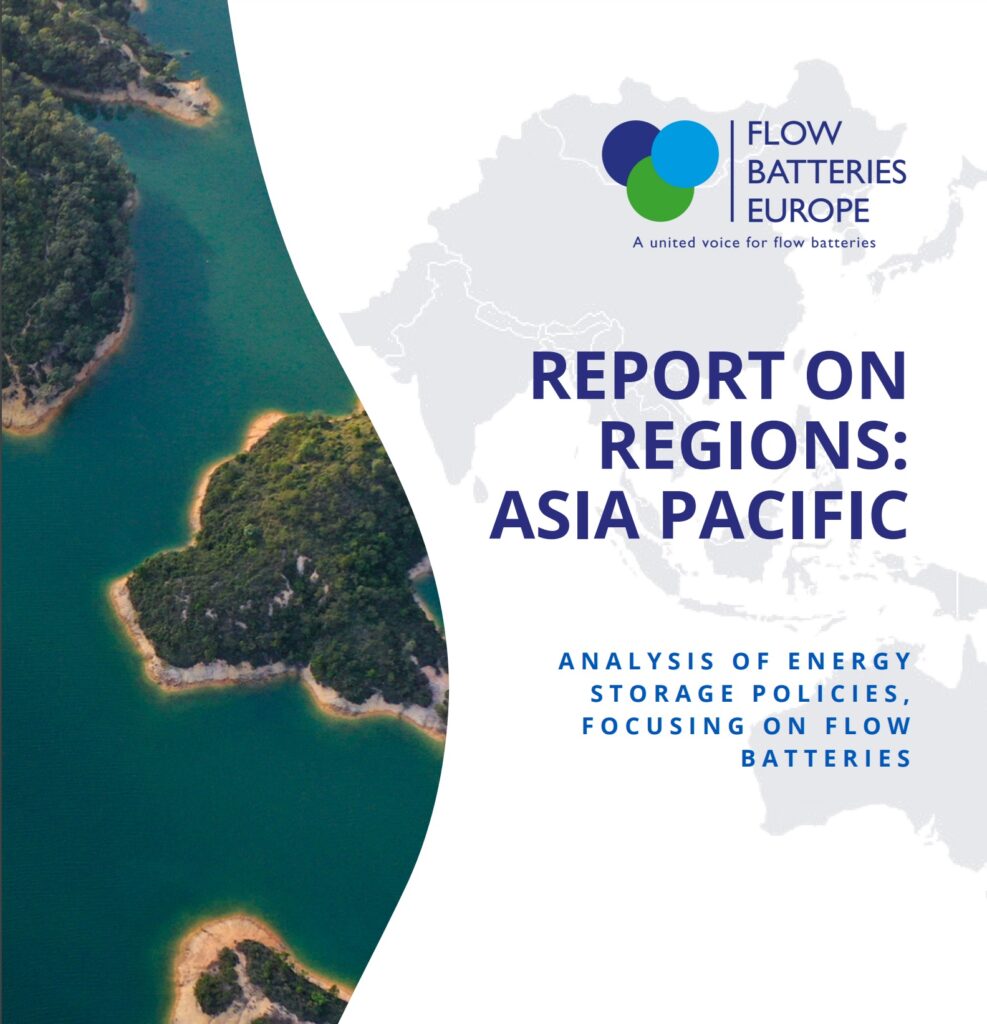
Flow Batteries Europe – Reports on Regions: Asia Pacific
The report provides a comprehensive analysis of the Asia Pacific energy storage and flow battery policy landscape, examining key countries like China, Japan, Australia, and South Korea.
Published in November 2024. Click here to download it!
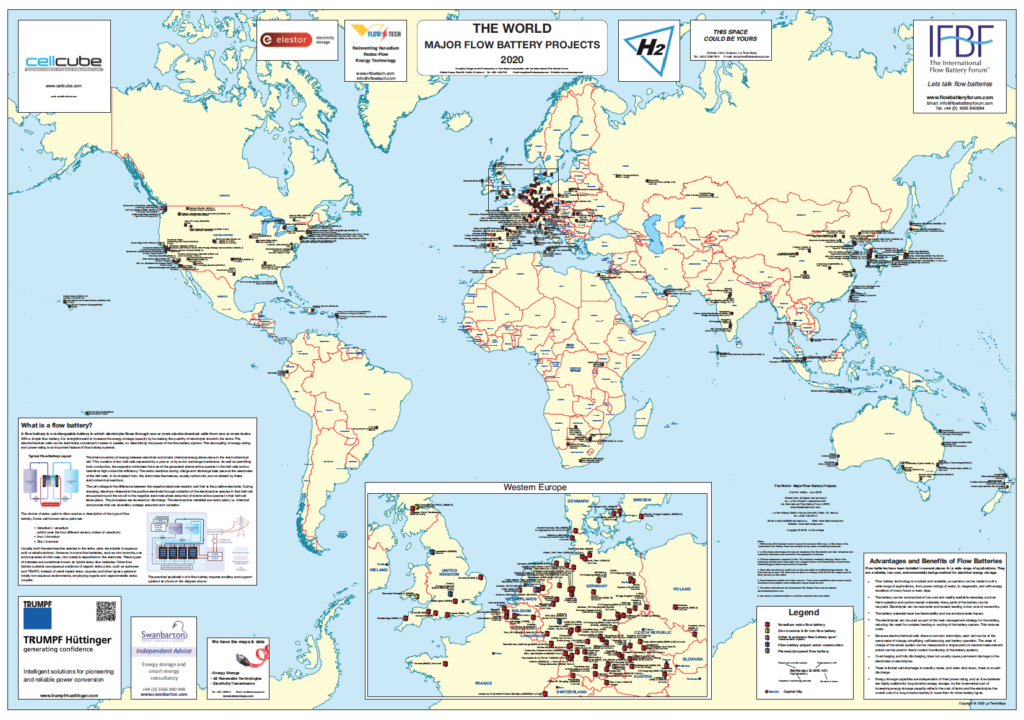
Major Flow Battery Projects 2020
Please click on the map to open a high-resolution PDF. To add your project or sponsor this map, please contact:
La Tene Maps
+353-1-2847914
enquiries@latenemaps.com
www.latenemaps.com
IFBF conference papers
The installations described on this page are documented in the IFBF conference papers, written each year by the presenters at the Forum. A complete list of previous conference papers is available here.
This page is maintained by the International Flow Battery Forum (IFBF), the annual conference of the flow battery community, held since 2010. The research summarised here is presented each year at the Forum and published in the IFBF Book of Papers.